
Halim is five. He has eaten the same two meals a day for most of his life, and none of them came in a bag.
No kibble. No commercial treats. No wet food from a can. Just rice, turkey, and a quarter of an apple — twice a day, every day. A few pieces of whatever vegetables Irina happens to be chopping, when she's chopping. That's it.
This is how we got here.
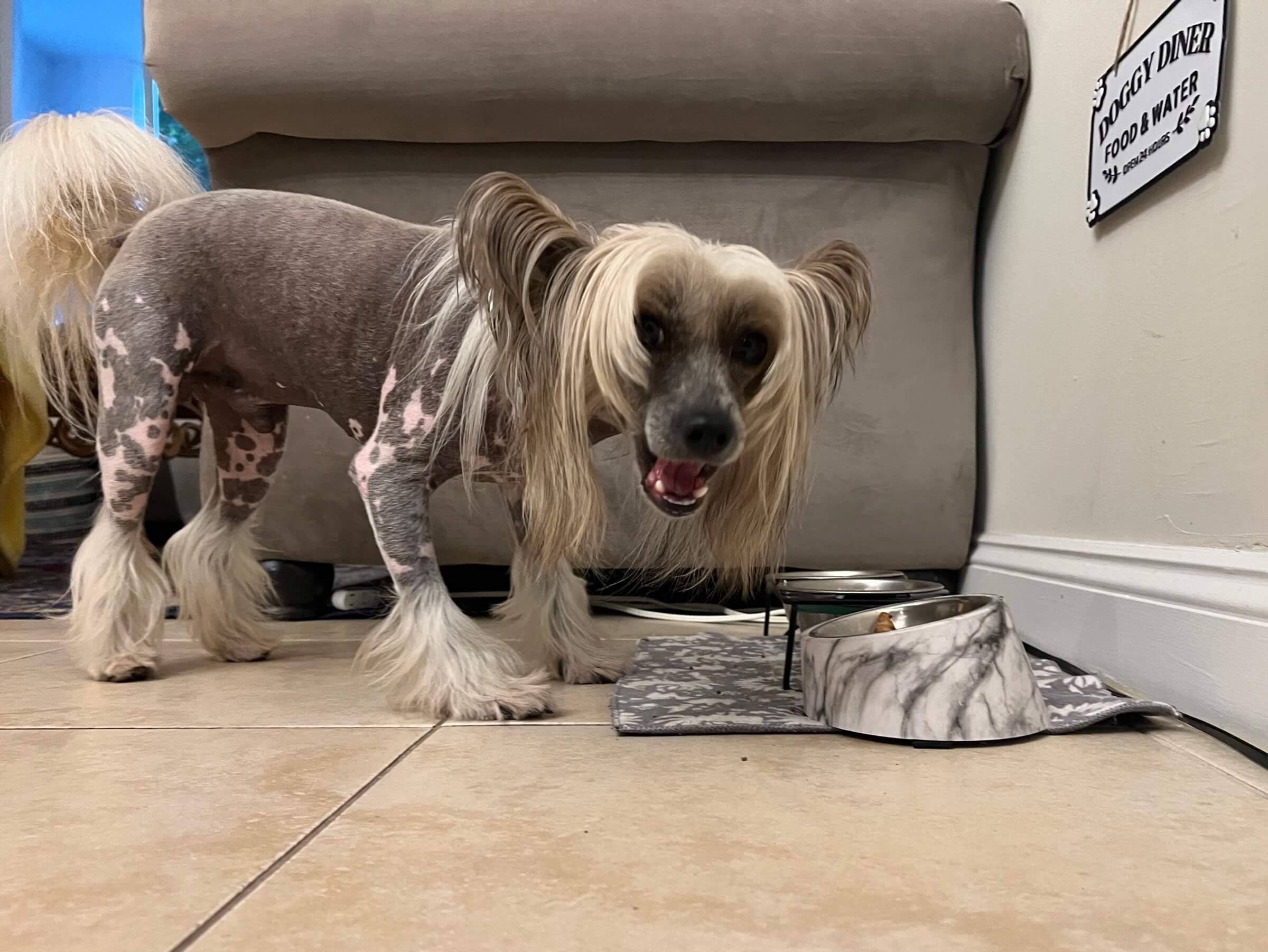
The bag phase
When Halim came home from the airport in June 2021 he was nine months old and a long way from Vladivostok. We had stocked the apartment with everything a new-dog checklist says to stock — a bag of small-breed kibble, a few cans of wet food, a packet of treats with picky eaters printed on the label.
He sniffed the kibble. Took two pieces to evaluate. Walked away.
Over the next few weeks we rotated through the brands you'd expect — Blue Buffalo, Hill's, Wellness, one of the grain-free bags with a happy setter on the front. Halim's response to each was polite and identical: token interest, minimal consumption, return to sender. He would skip meals for half a day and wait us out.
Wet food was no better. We'd open a can of something that smelled, to a human, like food, and Halim would look at it, look at us, and go lie down under the table.
We stopped trying, and Irina started cooking for him instead.
The chicken problem
There was also the skin.
Chinese Cresteds have a reputation for food sensitivity, and chicken is one of the most common triggers in the breed. Halim got the standard version of it — red ears, paw-licking at night, the occasional patch of pink on his belly. We ran an elimination and confirmed what was happening. He can't have chicken. Not chicken meat, not chicken broth, nothing with chicken fat or chicken meal on the ingredient list.
This turns out to be a real problem if you shop commercial dog food. Most bags on most shelves contain chicken in some form. Even the ones labelled lamb and rice usually list chicken fat third or fourth on the back. Once you start reading the small print, most of the aisle disappears.
Cooking for him removed the whole question.

What's in his bowl
Two meals a day. Same ingredients every time:
- 3–4 tablespoons of cooked white rice — Supreme Long Grain
- 150 grams of raw turkey — kosher ground turkey from Costco, hand-cut into roughly 1×1 cm cubes
- A quarter of a Gala apple — peeled, cored, diced small
That's the meal.
The turkey is raw, never frozen, straight from the fridge. The rice is pre-cooked in a batch every few days and gets thirty seconds in the microwave before serving. Warm rice plus cool turkey lands at roughly body temperature by the time it reaches the bowl.
Halim hears the microwave beep and comes to the kitchen. He eats the whole bowl, every time. No negotiation, no leftover crumbs.

Irina's rice
The rice is most of the meal, so the rice matters. This is exactly how Irina makes it. One batch lasts about five days in the fridge.
For one cup of rice:
- Rinse the rice under cold running water until the water runs mostly clear. Set aside.
- In a pot, combine 1½ cups of water, 1 teaspoon of salt, and 2 tablespoons of neutral oil. Bring to a rolling boil.
- Add the rinsed rice to the boiling water. Wait for it to return to a boil.
- Meanwhile, heat the oven to 350°F.
- Once the rice has come back to a boil, transfer the whole pot (lid on) into the hot oven — and turn the oven off.
- Leave it overnight.
In the morning the rice is finished. Fluffy, separate grains, no gummy bottom. Irina has been making it this way for years and it comes out the same every time.
Sometimes she adds diced carrot or broccoli to the pot with the rice before the oven step. Some weeks she makes buckwheat instead. When she does, no vegetables go in — buckwheat spoils faster when anything fresh is cooked with it.
The teaspoon of salt is worth mentioning. It's a small amount at Halim's portion sizes, well below what's harmful for a small dog, and it's what makes the rice taste like food to him. We tried unsalted rice early on. He ate it, but reluctantly. The salt stayed.
He would skip meals for half a day and wait us out. So we stopped trying, and Irina started cooking for him instead.
Vegetables, fruit, and bread
Outside of meals, Halim grazes on whatever Irina is chopping.
If she's prepping a salad, he's underfoot. He gets small pieces of raw carrot, cabbage, tomato, cucumber, the tender inner leaves of romaine. Not the peels, not the stems, nothing with oil or dressing on it. He has preferences — he'll take a cherry tomato without hesitation and politely leave a slice of cucumber on the floor for us to find later — but he tries most things.
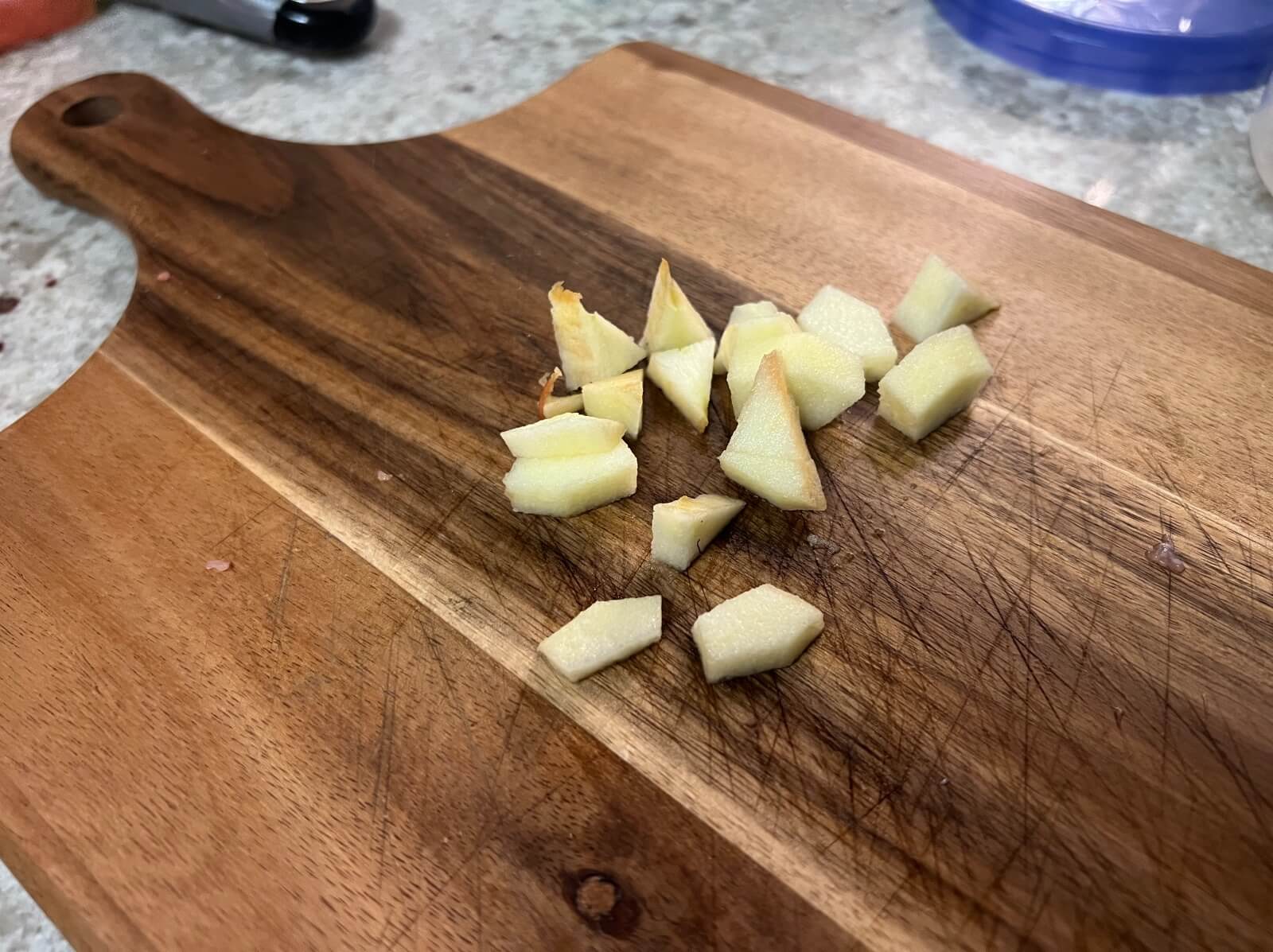
The apple is part of every meal. A quarter of a Gala, peeled, cored, diced into small chunks. Something about the sweetness works for him.
Bread is his one weakness. When there's fresh homemade bread in the kitchen, the smell gets Halim off the couch faster than the microwave does. He gets a thumbnail-sized piece while it's still warm. That's it for the day. Bread is filler, not food — but he treats it like an event.
What we don't add
- No kibble. Not as meals, not as toppers, not mixed in.
- No commercial treats. He won't eat them.
- No chicken, in any form.
- No canned dog food. Tried, refused, moved on.
- No vitamin supplements. Our philosophy is that a varied whole-food diet provides what he needs. Reasonable people can disagree with this. Our vet doesn't.
- No seasoned table food. Raw produce from the cutting board is fine. Anything with garlic, butter, extra salt, or sauces is not.
What the vet says
The question most people ask about a diet like this is whether a vet has signed off on it. Ours has.
Halim sees his vet every year in Miami. She knows exactly what he eats. We told her at an early checkup, fully expecting a lecture, and didn't get one. She asked what was in the food, asked about vegetables, nodded, and moved on.
Five annual checkups later: weight stable, coat in the condition a hairless dog's coat should be in (dry skin is the breed's eternal problem and has nothing to do with diet), bloodwork normal, teeth clean.
The only medication Halim takes is Simparica Trio, once a month — the combined flea, tick, and heartworm preventative. In Florida it isn't optional for any dog. Prescription-only, from the vet, the single pill in the house.
What works for him is not a template. It's what works for him.
One honest disclaimer
This isn't veterinary advice. It's what works for one dog.
Home-cooked diets done wrong can cause real problems — calcium gaps, nutritional deficiencies that don't surface for years, issues specific to puppies or large breeds or dogs with existing conditions. Halim is a small adult Chinese Crested with a specific allergy, cooked for consistently for five years. He isn't a puppy. He isn't a large breed. He isn't a dog with a known medical condition.
If you're thinking about moving your dog off commercial food, talk to your vet first — ideally one with experience in home-cooked or raw diets, because plenty of vets will default to buy the bag. For most dogs, most of the time, that's a legitimate default.
But if your dog is a picky eater, an allergic eater, or a breed with a known reputation for food sensitivity — Chinese Crested, Chihuahua, French Bulldog, Xolo, Shih Tzu — it's a conversation worth having.
Halim is five. The bowl comes back empty.
Want more from Halim? Join the newsletter for new reviews and the occasional photo, or come say hi in his Facebook group.